
September 9, 2026 • 10 min read
AI Scribes Aren’t All the Same — and the Differences Matter
AI scribe, AI medical scribe, clinical scribe, ambient scribe, AI note taker... there’s no shortage of names for AI tools that listen to conversations and help create documentation. But do all these names mean the same thing?
Not really. But nor is there currently a universally agreed definition separating an “AI scribe” from an “AI clinical scribe”. However, there can be a significant difference between a general-purpose AI tool that can take notes, and technology that has been purpose-built for healthcare settings and clinical documentation.
In this article, I explore some of the terminology being used today, where I think that terminology may head as the technology matures, and (perhaps more importantly) some more useful questions to ask when choosing an AI scribe while the lingo remains somewhat messy.
What’s in a name?
I spent more than 10 years of my early career as a data designer, which is really just a techy name for someone who designs how data is structured, organised and stored. So perhaps unsurprisingly, terminology is incredibly important to me. The words we use create expectations. They imply what something is, what it does and, sometimes, what it doesn't do.
That is why, when I hear terms such as AI scribe, medical scribe and clinical scribe used interchangeably, I often wonder whether we're actually talking about the same thing.
At the moment, sometimes we are. And sometimes we're not.
That's not unusual for an emerging technology. Products often evolve faster than the language we use to describe them. Initially, a broad term appears that is good enough. As products mature and capabilities diverge, those broad labels become less useful and clearer distinctions start to emerge.
My hope with this article isn't to establish a new industry taxonomy. It's simply to provide some clarity for people encountering these technologies for the first time, and to encourage us to think a little more carefully about what sits behind the name.
What is an AI scribe?
Today, AI scribe is often used as an umbrella term for technology that captures spoken interactions and uses AI to help produce written documentation.
Even regulators and professional bodies use several different terms. The Australian Therapeutic Goods Administration (TGA), for example, refers to “digital scribes”, “artificial intelligence (AI) scribes” and “ambient scribes”. Its current definition focuses on software used in clinical settings to capture conversations and generate clinical notes, summaries or letters.
Other organisations use terms including "AI scribe", "virtual scribe", "ambient AI scribe", "AI documentation assistant" and "clinical assistant".
So, the terminology is clearly still settling.
There is a useful parallel with the evolution of self-driving cars. Early discussions included terms such as driverless car, self-driving car, autonomous car, automated vehicle and driver assistance, despite significant differences in what the technology could actually do. Over time, more useful classifications emerged. SAE's Levels of Driving Automation now describes six levels, from Level 0 to Level 5, based on the capabilities of the technology rather than relying on ambiguous labels such as “self-driving”.
AI scribes may be at an earlier stage of a similar evolution.
Rather than focusing too heavily on the name, it may therefore be more useful to ask: What is the technology actually designed to do?
A spectrum of AI documentation tools
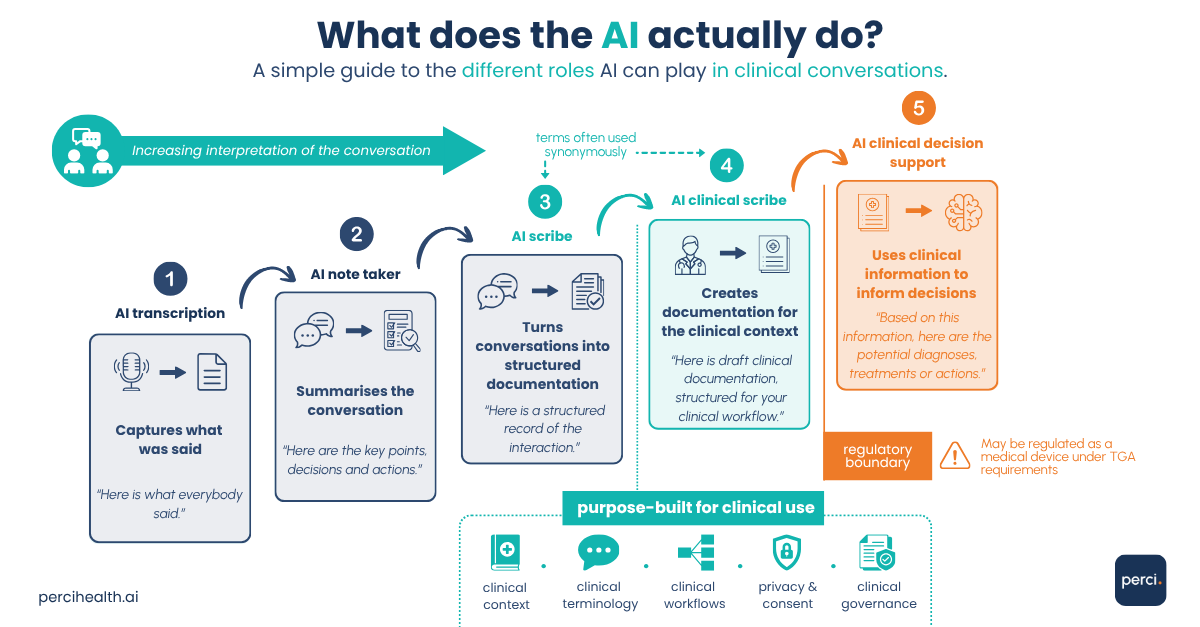
In my mind, there is a spectrum of AI technologies that can support healthcare professionals with conversations and documentation:
AI transcription → AI note taker → AI scribe → AI clinical scribe → clinical decision support
These aren't formal categories, and there is overlap in the terminology. But thinking about the capabilities this way can help illustrate some important differences.
AI transcription
“Here is what was said.”
Transcription converts spoken words into written text. Its primary task is capturing the conversation accurately rather than interpreting or restructuring it.
AI note taker
“Here are the important points, decisions and actions.”
An AI note taker goes a step further. Rather than simply providing a transcript, it interprets a conversation sufficiently to summarise what happened and identify information such as key points or actions. This can be very useful for meetings. But a useful meeting summary isn't necessarily useful clinical documentation.
AI scribe
“Here is a structured record of the interaction.”
An AI scribe moves beyond general summarisation and creates more structured documentation from a conversation. This is where terminology becomes particularly blurry. Many products described simply as “AI scribes” are designed specifically for healthcare and could equally be described as clinical or medical scribes.
AI clinical scribe
“Here is draft clinical documentation, structured for this clinical context and workflow.”
For me, the word clinical should convey something more than the fact that the technology happened to be used during a healthcare conversation. An AI clinical scribe should be designed around the requirements of clinical practice: the terminology, context, documentation structures, workflows, privacy requirements and governance involved in creating accurate and appropriate clinical documentation.
Clinical decision support
“Based on this information, here is what the diagnosis, treatment or next action might be.”
This is an important boundary. An AI scribe records and structures the healthcare professional's interaction, whereas clinical decision support goes further and analyses clinical information in order to inform decisions.
That distinction isn't merely semantic in Australia. The TGA states that a digital scribe intended only to convert clinical conversations into written records, without performing clinical analysis or interpretation, is not considered a medical device. If it generates diagnoses, differential diagnoses or treatment recommendations that were not explicitly stated by the healthcare professional, however, it is considered a medical device, and the relevant regulatory requirements apply.
What makes an AI clinical scribe different?
The difference becomes easier to see when you compare a general note-taking workflow with a clinical documentation workflow.
A general AI note taker might follow:
Conversation → transcription → summary
An AI clinical scribe needs to deal with something more complex:
Clinical interaction → understand clinical context → identify clinically relevant information → structure it appropriately → create draft clinical documentation → healthcare professional review and approval
There are several things behind that difference.
Clinical context and terminology
Healthcare conversations contain specialist terminology, abbreviations, symptoms, interventions, medications, assessments, anatomical references and profession-specific language.
An AI clinical scribe needs to handle this context reliably rather than simply produce fluent prose.
And “clinical terminology” isn't one vocabulary. The language used by a GP can be very different from that used by an occupational therapist, physiotherapist, psychologist, speech pathologist, nurse or rehabilitation consultant.
Clinical relevance
Not everything said during a clinical interaction belongs in the resulting documentation.
An AI clinical scribe needs to identify what is relevant, preserve important nuance and distinguish between concepts such as historical and current information.
This is considerably more consequential than deciding which parts of a business meeting belong in its minutes. An omission, incorrect clinical term or misplaced piece of information can affect the accuracy and quality of the documentation.
Clinical documentation structures
Useful clinical documentation also needs the right structure. SOAP notes are one familiar example, but healthcare documentation extends much further: assessments, interventions, functional capacity, treatment goals, progress, barriers, risk factors, recommendations, rehabilitation plans and case-management activities can all require different structures.
A well-written generic summary isn't automatically good clinical documentation.
Clinical workflow awareness
Clinical work also isn't always a doctor sitting across from a patient in a consulting room.
Healthcare professionals may need to document face-to-face consultations, telehealth sessions, telephone calls, assessments, treatment sessions, case conferences, stakeholder meetings, voice notes and other interactions.
A technology's suitability therefore depends partly on whether it has been designed around the real workflows of the people using it.
Privacy and security
The information being processed isn't ordinary meeting information. It can include highly sensitive health and personal information.
That makes questions such as where information is stored and processed, who can access it, how it is protected, whether it is retained, how it is deleted and whether it is used to train AI models especially important.
In Australia, health service providers are subject to the Privacy Act, with additional health privacy legislation applying in some states and territories.
Informed consent
Healthcare professionals also need to consider informed consent.
The TGA's guidance for digital scribes states that healthcare professionals are responsible for obtaining informed consent from patients before using these systems.
Recording laws can add another layer. Requirements vary across Australian jurisdictions and depending on the circumstances, so healthcare professionals and organisations should ensure their consent process complies with the laws that apply to them rather than assuming that a general meeting-recording approach is sufficient.
Importantly, consent isn't just about saying “this conversation is being recorded”. People should have enough information to understand what technology is being used, what it is being used for and how their information will be handled.
Clinical governance and human oversight
Finally, the AI shouldn't be treated as the author of the clinical documentation.
The healthcare professional remains responsible for ensuring the documentation is accurate and appropriate. AI-generated documentation therefore needs to be reviewed and, where necessary, edited before it is finalised.
That human oversight is one of the clearest differences between using AI to help write meeting notes and using AI as part of a clinical documentation process.
AI scribe vs AI clinical scribe
Put simply, the distinction looks something like this:
| General AI note-taking / scribe | AI clinical scribe |
|---|---|
| Captures and summarises conversations | Identifies clinically relevant information |
| Produces general notes or summaries | Produces draft clinical documentation |
| Uses general meeting structures | Supports clinical documentation structures and workflows |
| Understands general vocabulary | Understands clinical and profession-specific terminology |
| Success = a useful summary | Success = accurate, appropriate clinical documentation |
| Errors are generally inconvenient | Errors can create clinical, legal or compliance risks |
| Handles general personal/business information | Typically handles sensitive health information |
| User reviews the output | Healthcare professional reviews and approves the documentation |
Of course, the boundary isn't as neat as this table might suggest. As discussed earlier, many products called simply AI scribes are purpose-built for clinical use. That's precisely why looking at the capabilities behind the label matters.
Medical scribe or clinical scribe?
Another term commonly used is AI medical scribe. I think there is a useful distinction here too, although, again, it isn't an official one. “Medical scribe” has historically been strongly associated with doctors and medical consultations. Much of the early AI scribe market has similarly been designed around physician workflows.
But clinical documentation extends well beyond medicine. Nurses, occupational therapists, physiotherapists, psychologists, speech pathologists and many other healthcare professionals create clinical documentation. Their interactions, terminology, workflows and documentation requirements can be very different.
For that reason, I personally prefer "AI clinical scribe" (or "clinical scribe") as the broader term. It better reflects the breadth of healthcare professionals and clinical workflows these systems may need to support.
Clinical scribes still aren't all the same
Even the term clinical scribe only gets us so far. A system can be genuinely designed for clinical use and still be heavily optimised around one type of clinical interaction or profession. Consider the difference between:
- a GP consultation
- a paediatric occupational therapy assessment
- a physiotherapy treatment session
- a psychological consultation
- a workplace rehabilitation case conference
- a telephone call between a rehabilitation consultant and an employer or insurer
All are healthcare interactions. But the terminology, relevant information, structure, participants and resulting documentation can be very different.
This is where I think the next level of maturity in AI scribes will occur.
As the market evolves, the important question will increasingly become not simply: “Is this a clinical scribe?”
“Has this clinical scribe been designed for the way I actually practise?”
What should healthcare professionals look for in an AI scribe?
While the terminology remains messy, I wouldn't choose an AI scribe based primarily on what the vendor calls it. Instead, look behind the label. Ask whether the product:
- has been designed specifically for healthcare
- understands the terminology relevant to your profession
- produces the types of clinical documentation you actually need
- supports the different types of interactions you need to document
- gives healthcare professionals control over the final documentation
- has appropriate privacy and security protections for health information
- supports an appropriate informed-consent process
- clearly explains where information is processed and stored
- clearly distinguishes documentation assistance from clinical recommendations
- complies with any regulatory requirements that apply to its functionality
One particularly important question is: "Does the product document what the healthcare professional said, or does it independently make clinical suggestions?" In Australia, that distinction can change the product's regulatory status. The TGA states that digital scribes that generate diagnoses or treatment recommendations not explicitly stated by the healthcare practitioner are medical devices and must meet the applicable medical-device requirements.
That doesn't mean clinical decision support is inherently a bad thing. But healthcare professionals should understand when a product has crossed from documentation assistance into clinical decision support and whether the appropriate regulatory safeguards are in place. Functionality that sounds impressive isn't automatically functionality you should expect (or want) from an AI scribe. Sometimes, a scribe should simply be a very good scribe.
So, do the labels matter?
Perhaps not as much as we would like; at least not yet.
AI scribe, medical scribe, clinical scribe and ambient scribe are still used in overlapping ways, and I expect the language will continue to evolve as the market matures.
We've seen this happen with other technologies. As capabilities become better understood, terminology becomes more precise because users need better ways to distinguish what different products actually do.
Perhaps we'll eventually see clearer categories for AI scribes too.
Until then, look beyond the name. Ask what the technology was designed to do, what information it understands, what documentation it produces, what workflows it supports, what safeguards sit around it, and whether it was genuinely designed for your clinical setting.
Because while the label may be messy, those differences matter.
References and useful resources:
TGA: Digital scribes, 30 January 2026
Ahpra: Meeting your professional obligations when using AI in healthcare
Ahpra: Example of newer generative AI tools in healthcare
Australian Govt - ASD: Engaging with artificial intelligence, 24 January 2024
Australian Commission on Safety and Quality in Health Care: Artificial Intelligence resources, 30 April 2026
RACGP: Artificial intelligence (AI) scribes fact sheet, 29 June 2026
About Perci Health
Perci is an Australian AI clinical scribe purpose-built for allied health, rehabilitation and case management. Learn more